Monday, September 14, 2020

ENERGY IN CHEMISTRY - PART 1

  ENERGY IN CHEMISTRY - Part 1

Essential Question:  How many types of energy are there?

Learning Objective:  Differentiate between types of energy

SWBAT: 

  • Explore and explain different types of energy

 ASSIGNMENT:  TYPES OF ENERGY PAPER

HMMM... BE READY TO PARTICIPATE

  • How many types of energy can you name?
  • Why do we need energy for?
  • Where do you think energy comes from?

Screen Shot 2020-08-15 at 10.51.47 AM-1.png

Key Points:     https://www.ck12.org/group-assignments/89598

    • All organisms use different forms of energy to power the biological processes that allows them to grow and survive.
    • Kinetic energy is the energy associated with objects in motion.
    • Potential energy is the type of energy associated with an object’s potential to do work.
    • Chemical energy is the type of energy released from the breakdown of chemical bonds and can be harnessed 

Terms:

  • Chemical energy: The net potential energy liberated or absorbed during the course of a chemical reaction.
  • Potential energy: Energy possessed by an object because of its position (in a gravitational or electric field), or its condition (as a stretched or compressed spring, as a chemical reactant, or by having rest mass). Also known as "energy at rest."
  • Kinetic energy: The energy possessed by an object because of its motion, equal to one half the mass of the body times the square of its velocity. Also known as "energy in motion."

What is Energy?

Energy is the ability to do WORK. 

The energy in the universe is constant and it can be transferred and transformed. Energy does not get lost, only converted and transformed into other forms of energy. 

Energy is a property of objects which can be transferred to other objects or converted into different forms, but cannot be created or destroyed. Organisms use energy to survive, grow, respond to stimuli, reproduce, and for every type of biological process. 

The potential energy stored in molecules can be converted to chemical energy, which can ultimately be converted to kinetic energy, enabling an organism to move. Eventually, most of energy used by organisms is transformed into heat and dissipated into the universe (but not lost).

World's Most Asked Questions: What Is Energy?

Kinetic Energy

Energy associated with objects in motion is called kinetic energy. For example, when an airplane is in flight, the airplane is moving through air very quickly—doing work to enact change on its surroundings. The jet engines are converting potential energy in fuel to the kinetic energy of movement. A wrecking ball can perform a large amount of damage, even when moving slowly. However, a still wrecking ball cannot perform any work and therefore has no kinetic energy. A speeding bullet, a walking person, the rapid movement of molecules in the air that produces heat, and electromagnetic radiation, such as sunlight, all have kinetic energy.

Kinetic Energy Demonstrated with Crashing Spheres

Potential Energy

What if that same motionless wrecking ball is lifted two stories above a car with a crane? If the suspended wrecking ball is not moving, is there energy associated with it? Yes, the wrecking ball has energy because the wrecking ball has the potential to do work. This form of energy is called potential energy because it is possible for that object to do work in a given state.

Objects transfer their energy between potential and kinetic states. As the wrecking ball hangs motionlessly, it has kinetic and and  potential energy. Once the ball is released, its kinetic energy increases as the ball picks up speed. At the same time, the ball loses potential energy as it nears the ground. Other examples of potential energy include the energy of water held behind a dam or a person about to skydive out of an airplane.

Potential energy vs. kinetic energyWater behind a dam has potential energy. Moving water, such as in a waterfall or a rapidly flowing river, has kinetic energy.

Examples of potential energy

Chemical Energy

Potential energy is not only associated with the location of matter, but also with the structure of matter. A spring on the ground has potential energy if it is compressed, as does a rubber band that is pulled taut (stretched). The same principle applies to molecules. On a chemical level, the bonds that hold the atoms of molecules together have potential energy. This type of potential energy is called chemical energy, and like all potential energy, it can be used to do work.

For example, chemical energy is contained in the gasoline molecules that are used to power cars. When gas ignites in the engine, the bonds within its molecules are broken, and the energy released is used to drive the pistons. The potential energy stored within chemical bonds can be harnessed to perform work for biological processes. Different metabolic processes break down organic molecules to release the energy for an organism to grow and survive.

Chemical energy The molecules in gasoline (octane, the chemical formula shown) contain chemical energy. This energy is transformed into kinetic energy that allows a car to race on a racetrack.

PS3A - Definitions of Energy

Work and Energy: Transforming Chemical Energy into Heat - Virtual Lab

Cheeto Experiment

Energy in Foods Calorimetry Lab

“INTRODUCTION TO ENERGY” WORKSHEET               

Part 1.  The two basic types of energy                                                                                  

Directions:  Determine the best match between basic types of energy and the description provided. Put the correct letter in the blank.  


______1.  A skier at the top of the mountain                                                                  (a) Kinetic Energy

______2.  Gasoline in a storage tank                                                                                     (b) Potential Energy

______3.  A race-care traveling at its maximum speed                                            (c) Both forms of Energy

______4.  Water flowing from a waterfall before it hits the pond below

______5.  A spring in a pinball machine before it is released

______6.  Burning a match

______7.  A running refrigerator motor

Part 2.  Definitions of Energy

Directions: Write down the definition for each of the following terms after reading the article.


ENERGY:


KINETIC ENERGY:


POTENTIAL ENERGY:


Part 3.  Forms of Energy

Directions:  Determine the type of energy for each form (Kinetic, Potential, or Both) and give an example.

Form

Definition

Type (KE, PE, or Both)

Example (for each type if both)

Mechanical (motion) energy

An object’s movement creates energy


Thermal (heat) energy

The vibration and movement of molecules


Radiant energy


Electromagnetic waves


Electrical energy


Movement of electrons


Chemical energy


 Stored in bonds of atoms and molecules


Nuclear energy

Stored in the nucleus of an atom; released when nucleus splits or combines


Sound energy


Vibration of waves through material


Gravitational energy

Energy of position or height


Part 4.  Forms of Energy Continued

Directions:  Match the energy form(s) to the description provided. A few questions may have more than one answer.  


_____________1.  Falling rocks from the top of a mountain                                        (a) Mechanical

_____________2.  Release of energy from the Sun                                                             (b) Electrical

_____________3.  Energy released from food after it is eaten                                    (c) Heat

_____________4.  Batteries                                                                                                              (d) Radiant

_____________5.  The energy that runs a refrigerator                                                    (e) Chemical

_____________6. Nuclear fission reactors                                                                               (f) Nuclear

_____________7.  The rumble of thunder from a storm                                                  (g) Sound

_____________8.  Rubbing your hands together

_____________9.  Gasoline

_____________10. Food before it is eaten

_____________11. Lightening

Part 5.  Transformation of Energy

Directions: Use the following forms of energy to fill in the table below: mechanical, electrical, heat, radiant, chemical, nuclear, and sound.  The first one has been done for you.


ORIGINAL ENERGY FORM

FINAL ENERGY FORM

1.       Electric motor

electrical

mechanical

2.       A battery that runs a moving toy


3.       A solar panel on the roof of a house


4.       A person lifting a chair


5.       A nuclear power plant


6.       A toaster


7.       A church bell


8.       Gasoline powering a car


9.       A light bulb


10.     Photosynthesis


10.     Photosynthesis


CALORIMETER: HOW TO CALCULATE FOOD CALORIES USING A CALORIMETER

https://www.youtube.com/watch?v=Ak7PN8tn4cU


Grizzlies, 

Use the information on this video and the calculations given in class during my Lab Demo to calculate the amount of calories in half a Brazilian nut. 

Show me all the calculations.

USE THIS DATA FOR YOUR CALCULATIONS:

MASS = 40 GRAMS

INITIAL TEMPERATURE = 24 CELSIUS


Grizzlies,

If you have not done so yet, sign up in https://www.quia.com/web. 

Instructions are in your Homepage.   

 Sign up in your https://www.quia.com/web account and be ready to play a couple of games on ENERGY and ENERGY TRANSFER.

These games are meant to be educational and you will have a quiz on these new vocabulary terms. 

Look at the pictures below to ensure you can play the game and WIN!!

https://www.youtube.com/watch?v=Eizsm5V8c_c

https://www.youtube.com/watch?v=kNZi12OV9Xc

https://www.youtube.com/watch?v=eJXL0IrbtqE


Screen Shot 2020-09-08 at 1.39.53 PM.png


Screen Shot 2020-09-08 at 1.40.09 PM.png


Screen Shot 2020-09-08 at 1.40.17 PM.png


Screen Shot 2020-09-08 at 1.40.26 PM.png


Screen Shot 2020-09-08 at 1.39.53 PM.png


Screen Shot 2020-09-08 at 1.40.09 PM.png


Screen Shot 2020-09-08 at 1.40.17 PM.png


Screen Shot 2020-09-08 at 1.40.26 PM.png


Thursday, August 27, 2020

AREAS OF CHEMISTRY LECTURE

AREAS OF CHEMISTRY LECTURE

Essential Question: How many areas or fields of study are in chemistry?

Learning Objective:  List and define the five major areas or fields of study of chemistry.

SWBAT:

  • Investigate the five major areas of study in chemistry and their application.

ASSIGNMENT:  CK12 -  AREAS OF CHEMISTRY

HMMMM....

  • What do you, a tomato, an elephant, a piece of paper and a rotten piece of wood have in common?

Hmm.jpeg

Screen Shot 2020-08-16 at 11.40.44 AM-1.png

https://www.thoughtco.com/the-5-branches-of-chemistry-603911 (Links to an external site.)

There are many branches of chemistry (Links to an external site.) or chemistry disciplines. The five main branches are considered to be organic chemistry, inorganic chemistry, analytical chemistry, physical chemistry, and biochemistry.

There are other ways chemistry (Links to an external site.) can be divided into categories. Other examples of branches of chemistry might include polymer chemistry and geochemistry. Chemical engineering might also be considered a chemistry discipline. There is also overlap between disciplines; biochemistry and organic chemistry, in particular, share a lot in common.

Branches Of Chemistry (Links to an external site.)Branches Of Chemistry

Branches of Chemistry (Links to an external site.)Branches of Chemistry

Monday, August 24, 2020

HISTORY OF CHEMISTRY LECTURE: ALCHEMY


HISTORY OF CHEMISTRY LECTURE: ALCHEMY

HISTORY OF CHEMISTRY LECTURE: ALCHEMY

Essential Question:  What  did alchemy contribute to the field of chemistry?

Learning Objective: Explore a brief history on the principles of alchemy and how some of those principles helped develop the filed of chemistry

SWBAT:

  • Explore the contributions of alchemy to the field of chemistry

 ASSIGNMENT:  CK12  1.3: ALCHEMY

HMMM... BE READY TO PARTICIPATE

  • What is alchemy? 
  • Have you ever heard about The Elixir of Life? The Philosopher Stone?

Screen Shot 2020-08-15 at 10.51.47 AM-1.png

BRIEF HISTORY OF ALCHEMY TAKING FROM THE LINKS BELOW:

         The word alchemy is thought to derive from an Egyptian word, 'chem' or 'qem,'  or Khem meaning black — a reference to the black alluvial soils bordering the Nile. The Greek word 'chyma,' meaning to fuse or cast metals, established itself in Arabic as 'al kimia'  from which alchemy is derived."  

CHEM/QEM/KHEM   (black)     CHYMA   ( to fuse or cast metals)      to    AL KIMIA (arabic term)

       Alchemy is as old as the Pyramids (2000 BC). The concepts of Science and scientists had not been developed yet. Instead philosophers were the thinkers and creators of new ideas. When people think of Alchemy, they may also think of witchery and magical potions but alchemy was much more than that and may of the experiments performed lead to field of chemistry.

       Alchemy was based on the ancient belief that the Earth is made up of four basic elements in nature: air, water, fire and earth itself along with three essential substances: salt, mercury and sulfur. 

       At the time, the periodic table of elements had not yet being created and the concepts of elements was very basic. Alchemists divided elements into groups such as "mature" and "immature ."  According to alchemists, gold was the most perfect, mature metal because it contained the perfect balance of air, water, fire and earth.  Alchemists thought that by changing the composition of the air, the water, the fire and the earth they could "transmute" (change) immature elements such as copper or lead into gold. This is process of changing base metals into gold or silver is known as The Philosopher Stone. (Links to an external site.)

     The Philosopher Stone, thought to be a sort of powder, tincture or potion, was also thought to cure illness, prolong life and bring spiritual awareness. By drinking the potion, people could even achieve immortality. This was known as The Elixir of Life (Links to an external site.)

     Alchemists were never able to turn base metals into gold or silver or achieved immortality, but many of the experiments they performed such as the heating of mixtures, the addition of corrosive salts to metals gave rise to the field of chemistry.

https://www.youtube.com/watch?v=gxiLuz9kHi0&t=47s (Links to an external site.)

Alchemy’s influence on modern science (Links to an external site.)

Alchemy made important contributions to metalworking, refining, production of gunpowder, ceramics, glass, ceramics, ink, dyes, paints, cosmetics, extracts, liquors etc. Alchemists conceptualized chemical elements into the first rudimentary periodic tables and introduced the process of distillation to Western Europe. They were also among the first to extract metals from ores and compose various inorganic acids and bases.

Some examples:

  • Sulfuric acid was first described (approx. 1300 AD) by the alchemist, Pseudo-Geber. Sulfuric acid is the most used substance in chemical industries today after water, air, coal and oil.
  • The alchemist Andreas Libavius (1555 – 1616 AD) was the first to describe the preparation of free hydrochloric acid, of tin tetrachloride, and of ammonium sulfate.
  • Libravius and Pseudo-Geber described the preparation of aqua regia (“royal water”), a mixture of nitric acid and hydrochloric acid, which can dissolve gold.
  • The alchemist Albertus Magnus (1193-1280 AD) is often credited for the discovery of arsenic, although it was probably known to earlier alchemists.
  • Chinese alchemists invented gunpowder or black powder  in the 9th century.
  • Indian alchemy made important contributions to metallurgy. High-quality, high carbon steel was already being produced in India between 300-200 BC, and was exported throughout Asia and Europe.

Prof. Jim Al-Khalili presents - 1001 Inventions: Journeys from Alchemy to Chemistry (Links to an external site.)Prof. Jim Al-Khalili presents - 1001 Inventions: Journeys from Alchemy to Chemistry

https://www.youtube.com/watch?v=65hejDgciFo (Links to an external site.)

IMPORTANT LINKS TO READ:

http://www.chm.bris.ac.uk/webprojects2002/crabb/history.html (Links to an external site.)

https://www.livescience.com/39314-alchemy.html (Links to an external site.)

https://www.smithsonianmag.com/history/alchemy-may-not-been-pseudoscience-we-thought-it-was-180949430/ (Links to an external site.)


Saturday, August 22, 2020

HISTORY OF CHEMISTRY LECTURE

 HISTORY OF CHEMISTRY LECTURE

Essential Question:Where does Chemistry come from and who are some of the major contributors to the development of  this field?

Learning Objective: Explore a brief history of chemistry and describe practical contributors to the field

SWBAT:

  • Explore chemistry theories developed in the 19thcentury
  • Investigate some of the practical uses of modern chemistry

ASSIGNMENT: Write a paper about these two incredible scientists

  • Joseph Priestley 
  •  Antoine Lavoisier

       It was not until the era of the ancient Greeks that we have any record of how people tried to explain the chemical changes they observed and used. At that time, natural objects were thought to consist of only four basic elements: earth, air, fire, and water. Then, in the fourth century BC, two Greek philosophers, Democritus and Leucippus, suggested that matter was not infinitely divisible into smaller particles but instead consisted of fundamental, indivisible particles called atoms

      Unfortunately, these early philosophers did not have the technology to test their hypothesis. They would have been unlikely to do so in any case because the ancient Greeks did not conduct experiments or use the scientific method. They believed that the nature of the universe could be discovered by rational thought alone.

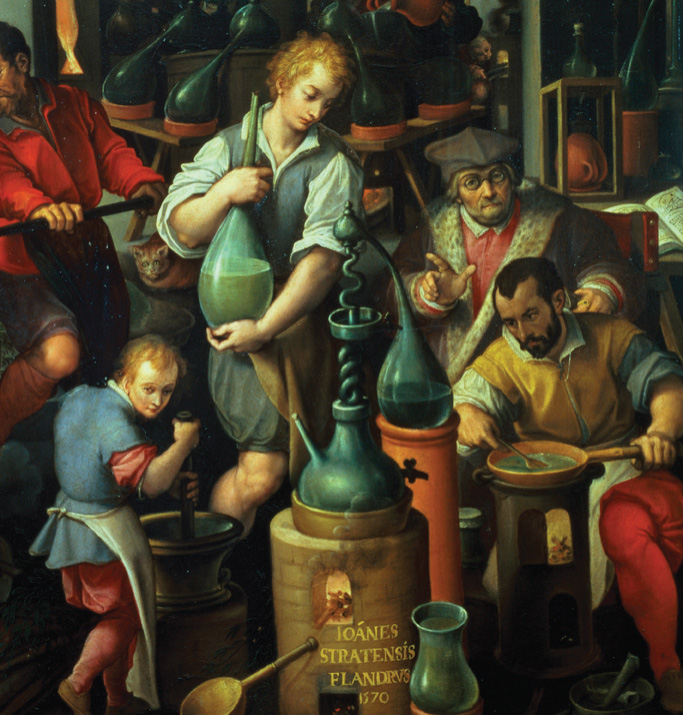
      Over the next two millennia, alchemists, who engaged in a form of chemistry and speculative philosophy during the Middle Ages and Renaissance, achieved many advances in chemistry. Their major goal was to convert certain elements into others by a process they called transmutation(Figure 1.13 "An Alchemist at Work"). 

      In particular, alchemists wanted to find a way to transform cheaper metals into gold. Although most alchemists did not approach chemistry systematically and many appear to have been outright frauds, alchemists in China, the Arab kingdoms, and medieval Europe made major contributions, including the discovery of elements such as quicksilver (mercury) and the preparation of several strong acids.

Figure 1.13An Alchemist at Work

Alchemy was a form of chemistry that flourished during the Middle Ages and Renaissance. Although some alchemists were frauds, others made major contributions, including the discovery of several elements and the preparation of strong acids.

MODERN CHEMISTRY

      The 16th and 17th centuries saw the beginnings of what we now recognize as modern chemistry. During this period, great advances were made in metallurgy, the extraction of metals from ores, and the first systematic quantitative experiments were carried out. 

      In 1661, the Englishman Robert Boyle (1627–91) published The Sceptical Chymist, which described the relationship between the pressure and the volume of air. More important, Boyle defined an element as a substance that cannot be broken down into two or more simpler substances by chemical means. This led to the identification of a large number of elements, many of which were metals. Ironically, Boyle himself never thought that metals were elements.

      In the 18th century, the English clergyman Joseph Priestley  and  Antonine Lavoisier made discoveries that will change the way people looked at chemistry. 


https://www.youtube.com/watch?v=z3Gt5IOjAuc&t=1502s


Friday, August 21, 2020

FAMOUS CHEMISTS


FAMOUS CHEMISTS LECTURE 

FAMOUS CHEMISTS


Essential Question:  Who are the scientists that paved the way to Modern Chemistry?

Learning Objective: Explore a brief history of famous chemists  and their contributions to the field of chemistry.

SWBAT:

  • Explore the contributions of famous chemists.
  • Acknowledge the role played by females and people of color chemists to the field of chemistry.

 ASSIGNMENT:  Famous Scientists paper

HMMM... BE READY TO PARTICIPATE

Screen Shot 2020-08-15 at 10.51.47 AM-1.png

  • Think  of and write down the name of some famous scientists? Do you know in what year or century they lived?
  • What kind of Science did they do?  What are they famous for?
  • When you think of scientists, what race or ethnic groups are less represented? Why do you think that is?

FAMOUS CHEMISTS:  Be ready to be called

Famous Chemists - 21 Greatest Chemists in History (Links to an external site.)Famous Chemists - 21 Greatest Chemists in History

Screen Shot 2020-08-15 at 11.27.34 AM.png

http://famouschemists.org (Links to an external site.)

https://www.livescience.com/46020-chemistry-history.html (Links to an external site.)

http://totallyhistory.com/biography/famous-chemists/ (Links to an external site.)

FAMOUS BLACK CHEMISTS: 

Screen Shot 2020-08-15 at 11.09.09 AM.png

https://cen.acs.org/people/profiles/Six-black-chemists-should-know/97/web/2019/02 (Links to an external site.)

https://www.thoughtco.com/black-chemists-and-chemical-engineers-606873 (Links to an external site.)

Five Black Chemists Who Changed the World (Links to an external site.)Five Black Chemists Who Changed the World

Mentoring the Next Generation of Black Chemists (Links to an external site.)Mentoring the Next Generation of Black Chemists

FAMOUS FEMALE CHEMISTS: 

https://www.distillerytrail.com/blog/12-famous-female-chemists-in-history-infographic/ (Links to an external site.)

https://www.ranker.com/list/famous-female-chemists/reference (Links to an external site.)

Women in science who changed the world (Links to an external site.)Women in science who changed the world

These Two Chemists Changed The World (Links to an external site.)These Two Chemists Changed The World

Dr. Marie Maynard Daly: The First African-American PhD. in Chemistry (Links to an external site.)Dr. Marie Maynard Daly: The First African-American PhD. in Chemistry

Screen Shot 2020-08-15 at 10.57.12 AM-1.png


Monday, August 10, 2020

WELCOME BACK - INTRO TO CHEMISTRY

CLICK HERE FOR WEBEX LINK

WELCOME BACK: PRIDE NIGHT VIDEO LINK


class intro.png

Dear Grizzlies,  welcome to my online Chemistry class!                                                                    

Chemistry is in every aspect of our lives. From the food we eat to the shampoo we use, to the processes inside of your cells that allow the food you just ate to become so small that they can now move in and out of your cells' membranes. If you like cooking or baking, you are already a Chemist!       
Have you ever observed a  rusted piece of metal? That metal underwent a chemical process called oxidation. (Links to an external site.) What causes oxidation? (click the blue word to watch a cute video).
Hmmm.... What about curly hair? You guessed it! Chemistry again! The protein in your hair contains sulfur atoms. Sulfur atoms pair up to form disulphide bonds. It is the distance between these sulphur atoms that makes hair curl. The further apart the atoms are, the curlier the hair is (you read it right!).  
My hair is wavy.  Hmm... Why do you think that is? What about your hair? 

                                   hair.png

                        disulfied bonds.png


The following units represent the material we will attempt to cover during the year. I will present these subject matter using different methods including lectures, video conferences and several websites. As the year progresses, I will update each unit by adding content to it.  
it is extremely important that you follow up and are on top of each assignment. Chemistry builds up on previous knowledge and falling behind in your work load will make it difficult for you to understand future lectures and assignments. 

I am looking forward this new academic year despite its many challenges!

Please, feel free to contact me to the email address below:
ncarter@sjusd.org     


image001-1.png


Wednesday, April 22, 2020

REVIEW ON ATOMS (REGULAR CHEMISTRY DURING COVID-9 SCHOOL CLOSURE) PERIODS 3 AND 8

                                 ATOMS 

Hi Students in Periods 3 and 8 (regular Chemistry). I decided to go way back, to the beginning of school and review some very important concepts already presented in class. 
The idea is to help those students in need of credit recovery and to allow others to refresh and reinforce what they have already learned in the past. 

If you want to advance more in your knowledge, you can visit my new post called CHEMICAL REACTIONS WEBQUEST in this blog and work on the assignment on Types of Chemical Reactions. 

Please, visit and do the work assigned in CK-12  regarding ATOMS and use these videos to refresh your memory.

http://www.youtube.com/watch?v=h6LPAwAmnCQ  Basic structure of atoms GOOD
http://www.youtube.com/watch?v=dRfrvpVdKGM Atomic number and mass GOOD
http://www.youtube.com/watch?v=kBgIMRV895w Discovery of subatomic particles
http://www.youtube.com/watch?v=3nge3LrK1S0  Atoms and the periodic table Mr. Andersen- GOOD

ISOTOPES:
http://www.youtube.com/watch?v=0oNkrj849s0 GOOD
https://www.youtube.com/watch?v=6CfSyGd5Ry4   Atomic Mass: How to Calculate Isotope Abundance
https://www.youtube.com/watch?v=ULRsJYhQmlo How to Calculate Atomic Mass Practice Problems